
October 05, 2026
Updated October 22nd, 2026 (see below)
Authored by Paula R. Worthington
Click to read the full report.
Key Takeaways
- Illinois SNAP enrollment is falling rapidly. Enrollment declined 22.4% between January 2025 and July 2026, compared with a 14.6% national decline through May 2026.
- Working-age adults have experienced the largest enrollment losses as H.R. 1’s work requirements take effect. Enrollment among Illinois adults ages 18–64 fell 24.8% from October 2025 through June 2026, coinciding with expanded work requirements and stricter limitations on benefit durations for able-bodied adults without dependents (ABAWDs) who do not meet those requirements.
- Adults aged 55—64 are an important group to watch. H.R. 1 expanded ABAWD work requirements to include these "near-elderly" adults, while enrollment fell 21.1% among ages 55–59 and 19.6% among ages 60–64 from October through June.
- Nearly 100,000 fewer Illinois children were enrolled in SNAP by June 2026 than in October 2025. That represents a 14.0% decline in enrollment among children ages 0–17.
- Falling SNAP participation could have spillover effects on school meal funding. There is no evidence of an impact on Chicago Public Schools yet, but lower SNAP enrollment could eventually reduce federal reimbursements for school meals.
- Illinois still faces a substantial potential fiscal penalty for its high SNAP payment error rate. If the FY2025 error rate of 14.67% does not improve, the State could owe just under $500 million annually beginning in federal fiscal year 2029.
- Lower enrollment reduces the State’s potential fiscal exposure but also means less federal food assistance reaching Illinois households. Food pantries are already reporting increased demand, raising concerns about additional pressure on the safety net.
Executive Summary
The USDA’s Supplemental Nutrition Assistance Program (SNAP) is changing rapidly as H.R. 1’s provisions take effect. Program enrollments are dropping nationwide, and states are under increasing pressure to implement H.R. 1’s additional work requirements and improve program administration, with significant future financial penalties for states whose payment error rates remain elevated.
We now have updated data through July 2026 that allows early examination of enrollment trends since federal policy changes took effect, particularly the February 1 date at which work requirements and time limit rules changed for some SNAP enrollees. Based on that data, we share updated enrollments with a special focus on two particularly vulnerable groups: near-elderly adults ages 55-64 and children up to 17 years of age. We also revise our estimate of future financial penalties for the State if its payment error rate does not come down.
Key findings include:
- Enrollment: SNAP enrollment declined in July to 1.48 million individuals in Illinois, far below the COVID-era peak of 2.1 million, and only 83.4% of January 2020 enrollments. Since January 2025, enrollment has fallen 22.4%.
- Working age adults: Data from the Illinois Department of Human Services suggest that H.R. 1’s expanded work requirements may be driving some of the observed enrollment decreases among adults. From October 2025 through June 2026, enrollment declines among working age adults—ages 18 to 64--have been much sharper than those for children and the elderly. Given the limited evidence that displaced adult enrollees will find employment at similar levels, this highlights the need to manage any increased food and nutrition needs in this group—especially the near elderly, ages 55 to 64, who may find it especially difficult to find employment.
- Children: Nearly 100,000 children ages 0 to 17 have fallen off the SNAP rolls in Illinois since October 2025—a decline of 14.0%. Children of school age may also feel H.R. 1 impacts via decreased future federal reimbursements to schools for providing school lunches and breakfasts. Chicago Public Schools included over $200 million in its 2025-2026 budget in such reimbursements.
- Looming fiscal impacts: The Civic Federation estimated Illinois’s annual potential financial penalties at nearly $550 million as of July 2026, due to the State’s elevated payment error rate, which was 14.67% in FY 2025. Continued sharp enrollment declines and modest decreases in the average monthly benefit per enrollee now point to an annual fiscal cost of just under $500 million starting in federal fiscal year (FFY) 2029.
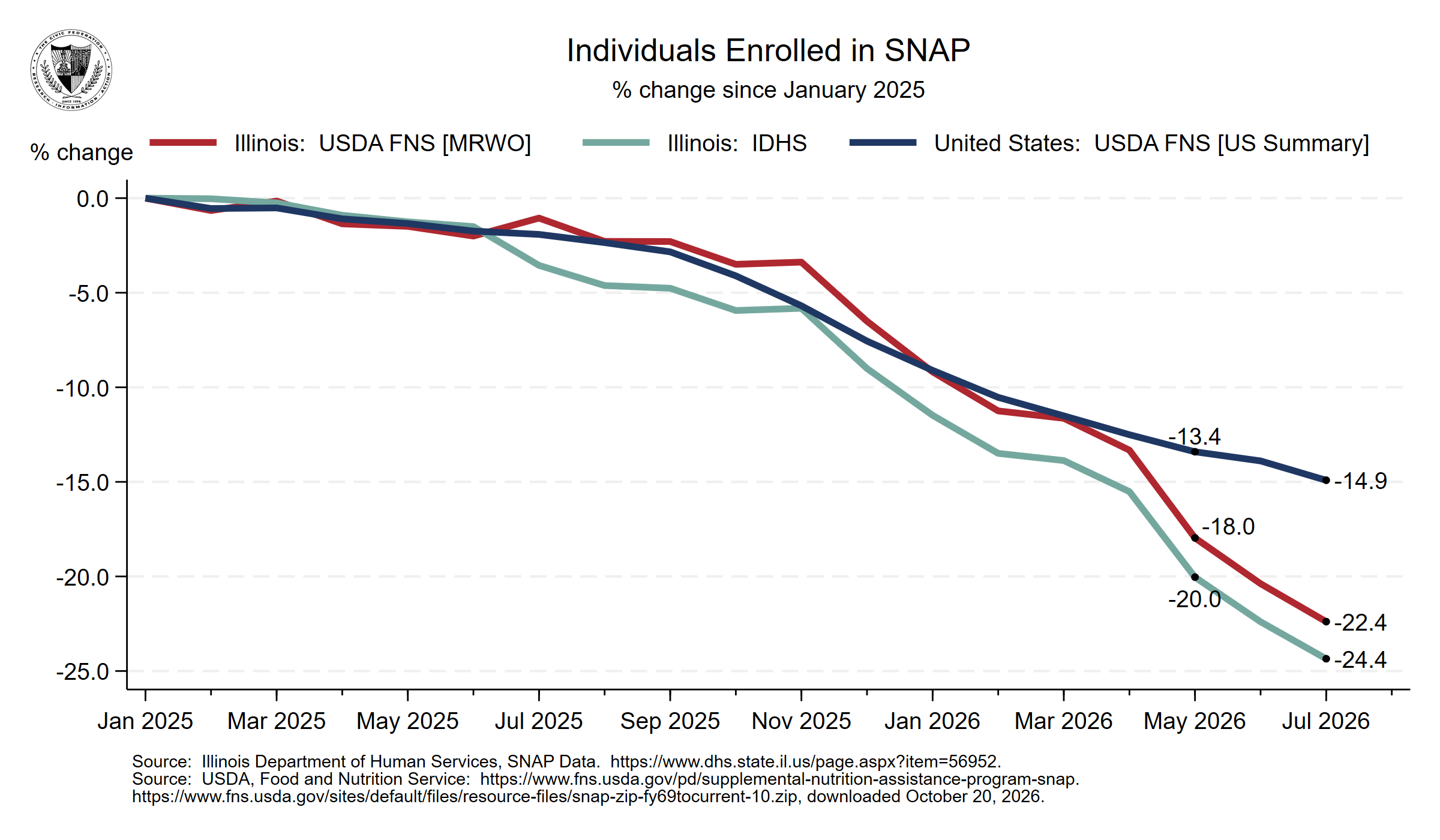
October 22nd, 2026 update: Data revisions and apparent data discrepancies have led us to revise the graph on page 3 of our report1. In the original graph, the drop in SNAP enrollments in Illinois tracked that of the US fairly closely until November 2025. By May 2026, the Illinois-US gap was (18.0 – 14.6) = 3.4 percentage points (pp) - meaning enrollments were falling faster in Illinois than in the nation as a whole. Using revised national data and relying on the state’s own IDHS SNAP enrollment data changes the timing and size of the gap between Illinois and the US:
- Newly revised national figures [navy blue line] suggest smaller enrollment declines than previously estimated - that makes the “gap” larger.
- Compared with the USDA’s Food and Nutrition Service data on Illinois’s enrollments analyzed in the brief [red line], the state’s own data reported by IDHS [teal line] shows higher enrollments from January through June of 2025, meaning that subsequent decreases are even larger in percentage terms - also making the gap larger.
On balance, the revised data for the US and the IDHS data for Illinois now show Illinois SNAP enrollments have fallen much more than nationally (24.4-14.9 pp = 9.5 pp by July 2026), with the gap starting to emerge in July 2025, narrowing by November 2025, and then widening since then.
1We thank Diane Schanzenbach for bringing these issues to our attention.