
December 23, 2025
A statement from the Civic Federation in response to the City of Chicago FY2026 Final Budget.
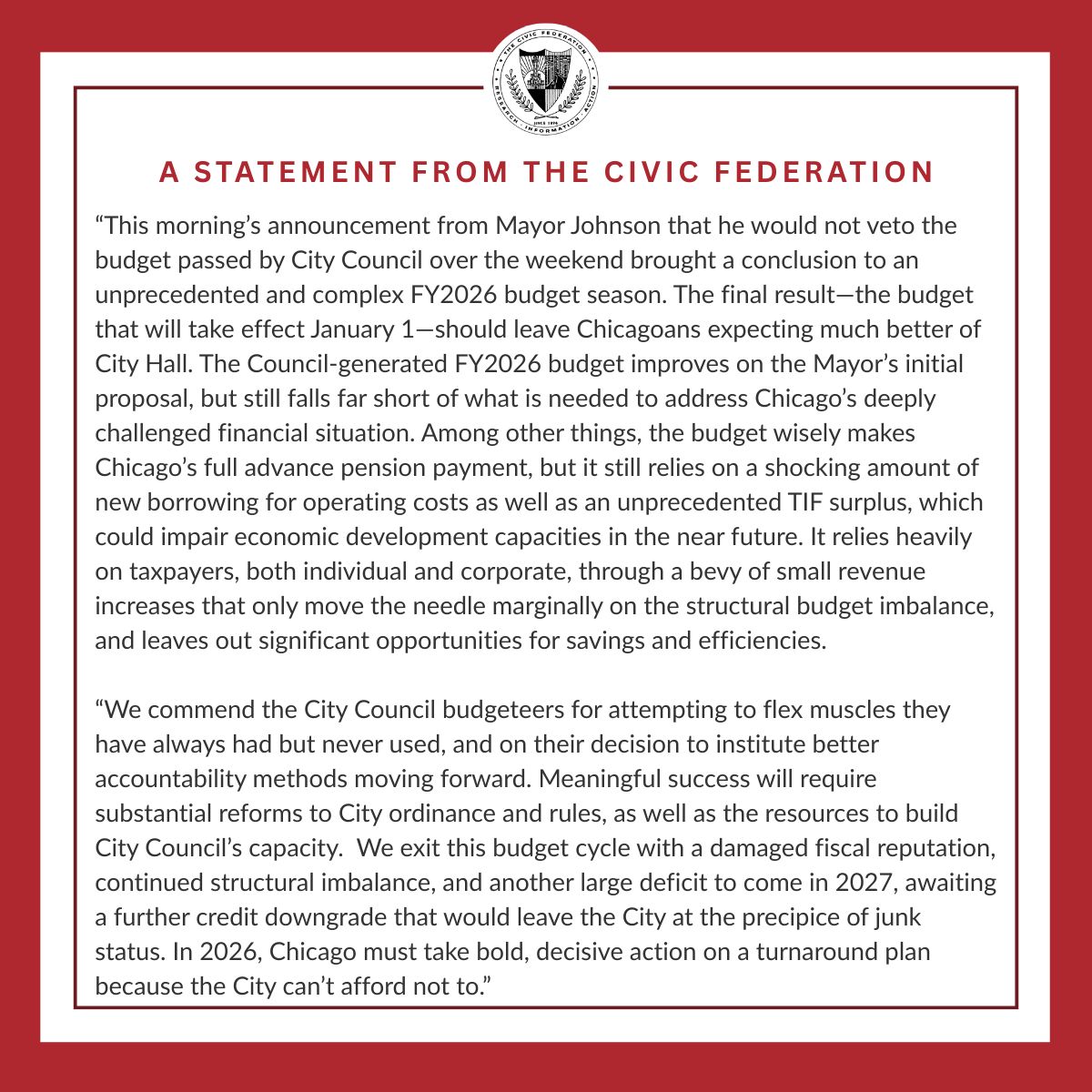
This morning’s announcement from Mayor Johnson that he would not veto the budget passed by City Council over the weekend brought a conclusion to an unprecedented and complex FY2026 budget season. The final result—the budget that will take effect January 1—should leave Chicagoans expecting much better of City Hall.
The unprecedented Council-generated FY2026 budget that will now take effect has improved on the Mayor’s initial proposal but still falls far short of what is needed to address Chicago’s deeply challenged financial situation. Among other things, the Council budget wisely makes Chicago’s full advance pension payment. But it still relies on a shocking amount of new borrowing for operating costs as well as an unprecedented TIF surplus, which could impair economic development capacities in the near future. Already flush with borrowing authority, City Hall authorized even more. In other words, the final budget sticks to some of the very decisions that credit rating agencies warned would bring new downgrades, and with them, higher debt service costs. In a worst-case scenario, this could also mean tightening access to credit markets in the coming years.
Neither the Mayor’s budget proposal nor the version passed by City Council reflects meaningful burden sharing among all stakeholders. Instead, the budget relies heavily on taxpayers, both individual and corporate, through a bevy of small revenue increases that only move the needle marginally on the structural budget imbalance and leave the City looking at a similar budget deficit next year. The budget also leaves out significant opportunities for savings and efficiencies – falling short on cost-cutting and leaving employees completely off the hook. Only a handful of the efficiencies proposed by EY are implemented in the Council budget, while simultaneously approving raises for non-union city employees and senior executives. That failure to include efficiencies is not the fault of the City Council budgeteers, who appear to have been obstructed by the Administration at most every turn from meaningful access to data and information backing the Mayor’s original proposal, despite repeated best efforts.
We commend the City Council budgeteers for attempting to flex muscles they have always had but never used, and on their decision to institute better accountability methods moving forward. Meaningful success will require substantial reforms to City ordinance and rules, as well as the resources to build City Council’s capacity. But this is new territory, so mistakes will be made. For example, a more robust Management Ordinance was not to be accompanied by the funding resources to effectuate its intentions.
Some weeks ago, this chaotic, unseemly exercise became more about winning than about securing Chicago’s financial future. The reality, however, is that there are no winners in this budget. And the City now must move forward in an even more dysfunctional and unstable political state than last year. We exit this budget cycle with a damaged fiscal reputation, continued structural imbalance, and another large deficit to come in 2027, awaiting a further credit downgrade that would leave the City at the precipice of junk status. Early in the new year, the Civic Federation will publish detailed analysis of the final budget and as well as recommendations for reforming the budgeting process for the year ahead. In 2026, Chicago must take bold, decisive action on a turnaround plan—the City can’t afford not to.